/ˈfeɪzɪk/

Thin-film optics, on one screen.

Precisely predict the optical behavior of multilayer thin-film stacks — through to automatic optimization — and reuse the same layer stack across all four modules. From AR coatings to OLED efficiency and solar-cell Jsc in a single click, while Needle-Tunneling adds new layers to complete the design.

From every layer's thickness optimization to automatic synthesis of new layers
— leave it all to , and focus on innovation!!

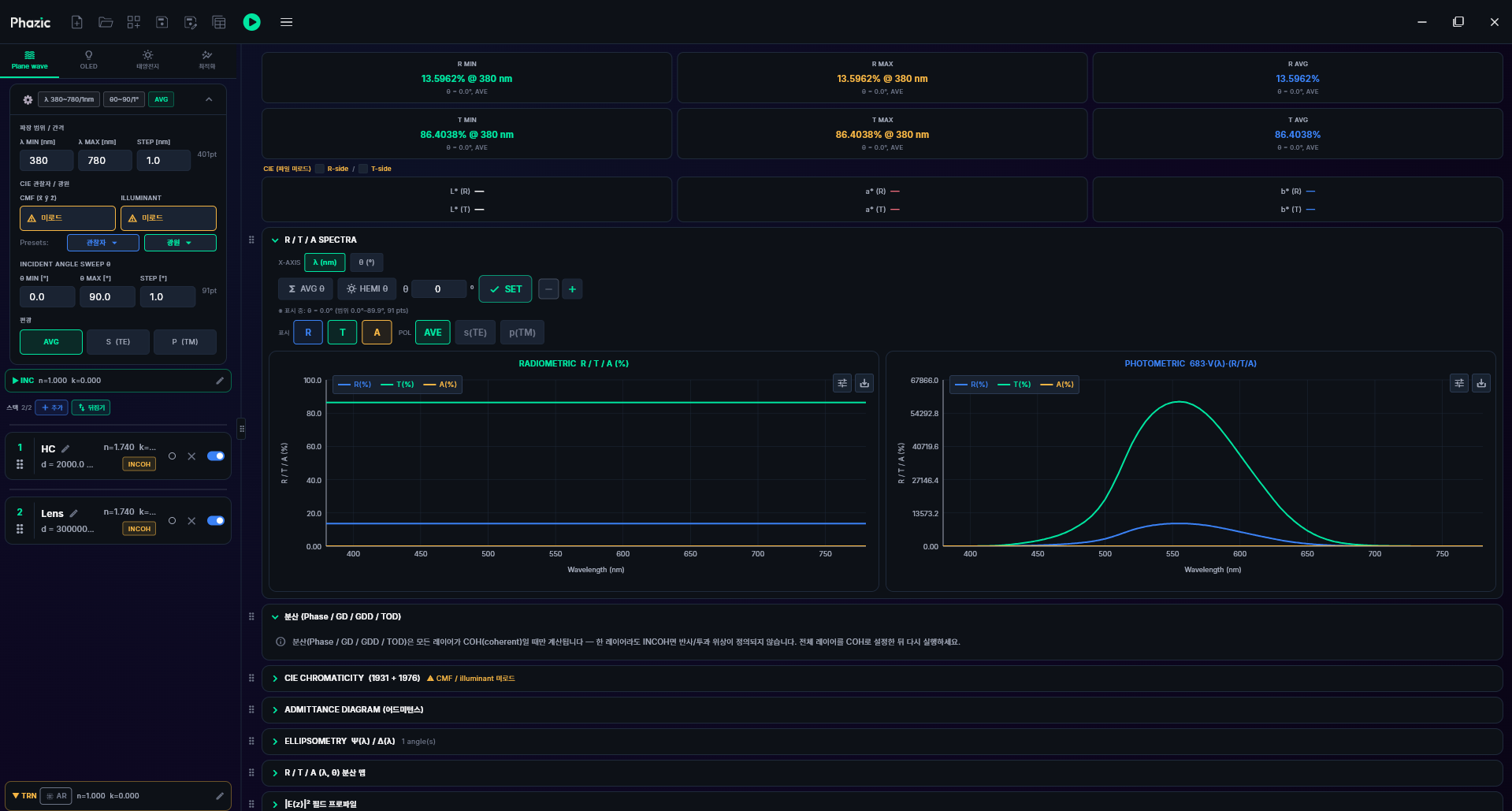
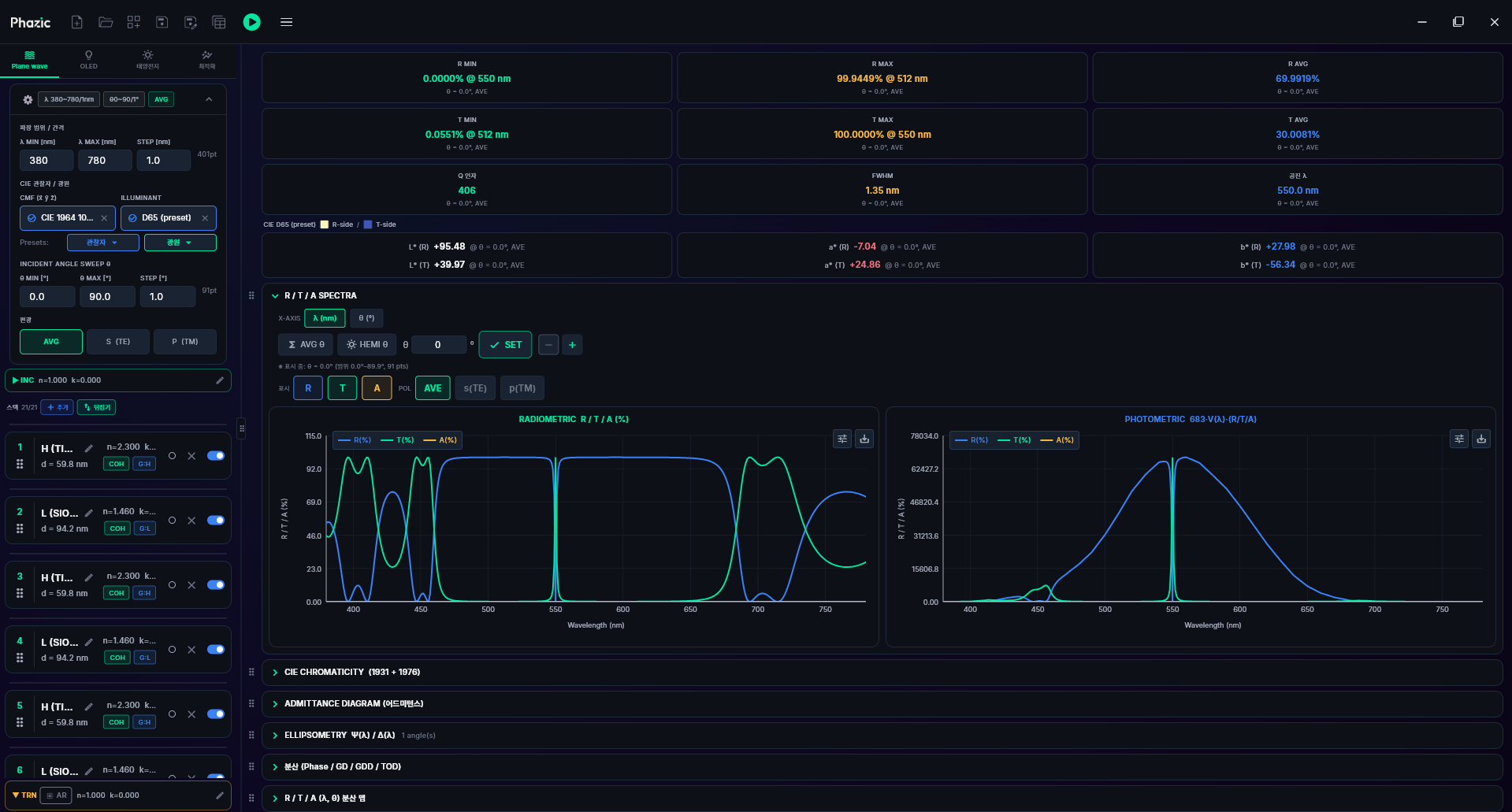
Phazic UI
Why Phazic?

Unbreakable accuracy.
A head start.

Most tools make you trade off — a stable engine or a friendly one, thin-film or OLED, design or measurement fitting. Phazic refuses the trade-off. Here is what actually sets it apart.
Reach out anytime — Phazic puts your needs first.

01 · Engine

A numerically stable S-matrix core

Phazic runs on a Redheffer S-matrix, not a textbook transfer matrix. Thick metal electrodes, deep Bragg mirrors, high-angle OLED emission (high‑k) and surface plasmons stay finite and accurate — right where naive TMM tools overflow into NaNs.

Phazicbounded & accurate end-to-end
02 · Intuitive UI

An interface anyone can use

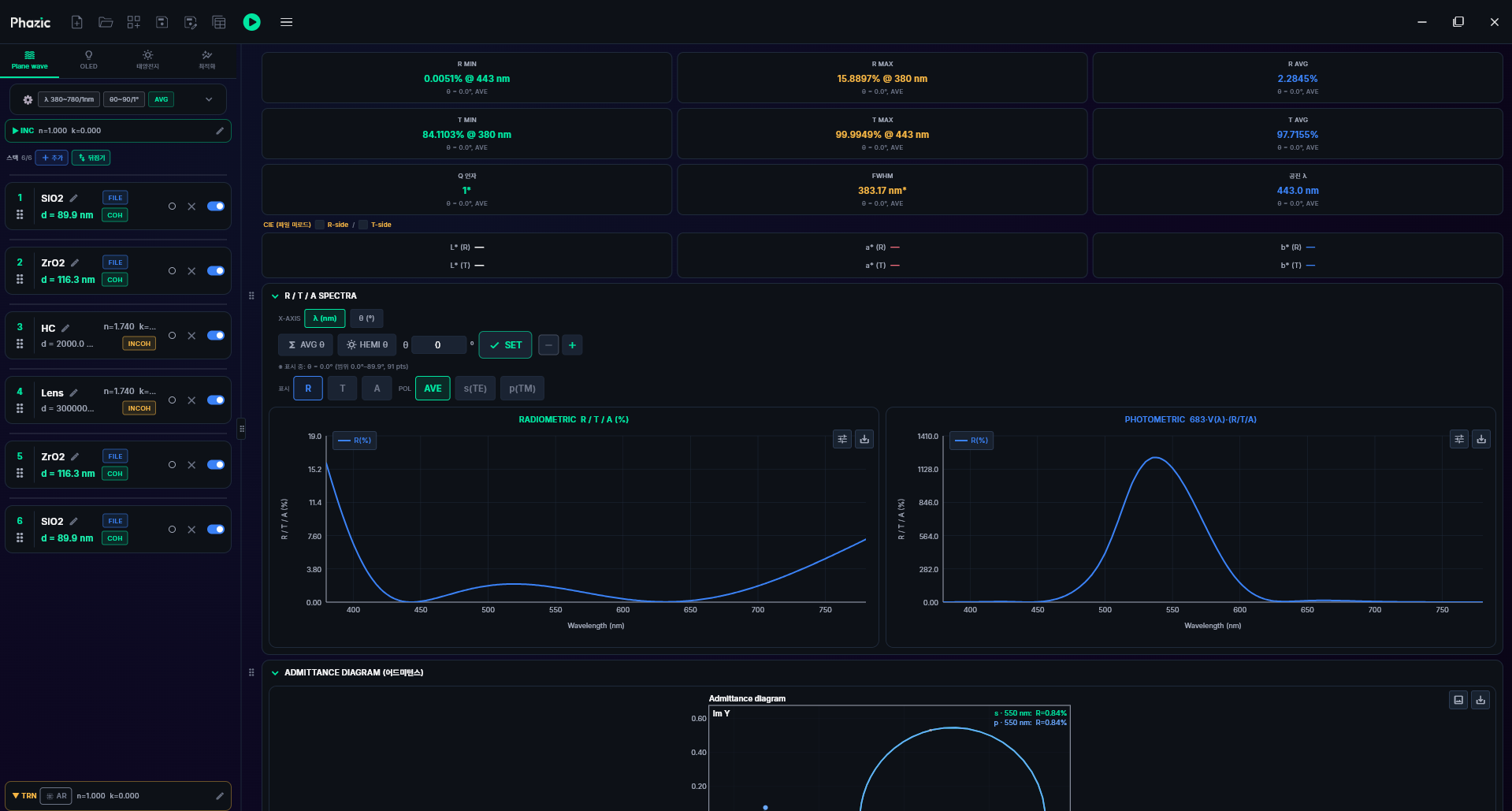
Add or delete a layer with a single click, drag to reorder, and group layers of the same type together. Copy & paste is effortless — and every result exports freely, as an image or as a data file.

Phazicclick & drag · save as image or data
03 · Templates

20 templates, 46 ready presets

Never start from a blank screen. One click loads a realistic, editable stack — from AR coatings and Bragg mirrors to VCSELs, Tamm / ENZ plasmonics, bandpass filters, perovskite tandems and thermophotovoltaics.

Phazica real design in one click
04 · One app

Four workflows, one project

Plane-wave optics, OLED dipole emission, solar-cell absorption and automatic optimization all share the same materials and stack. You switch tabs — not software.

Phazicone UI, one shared project
05 · Optimize

Optimization that adds layers

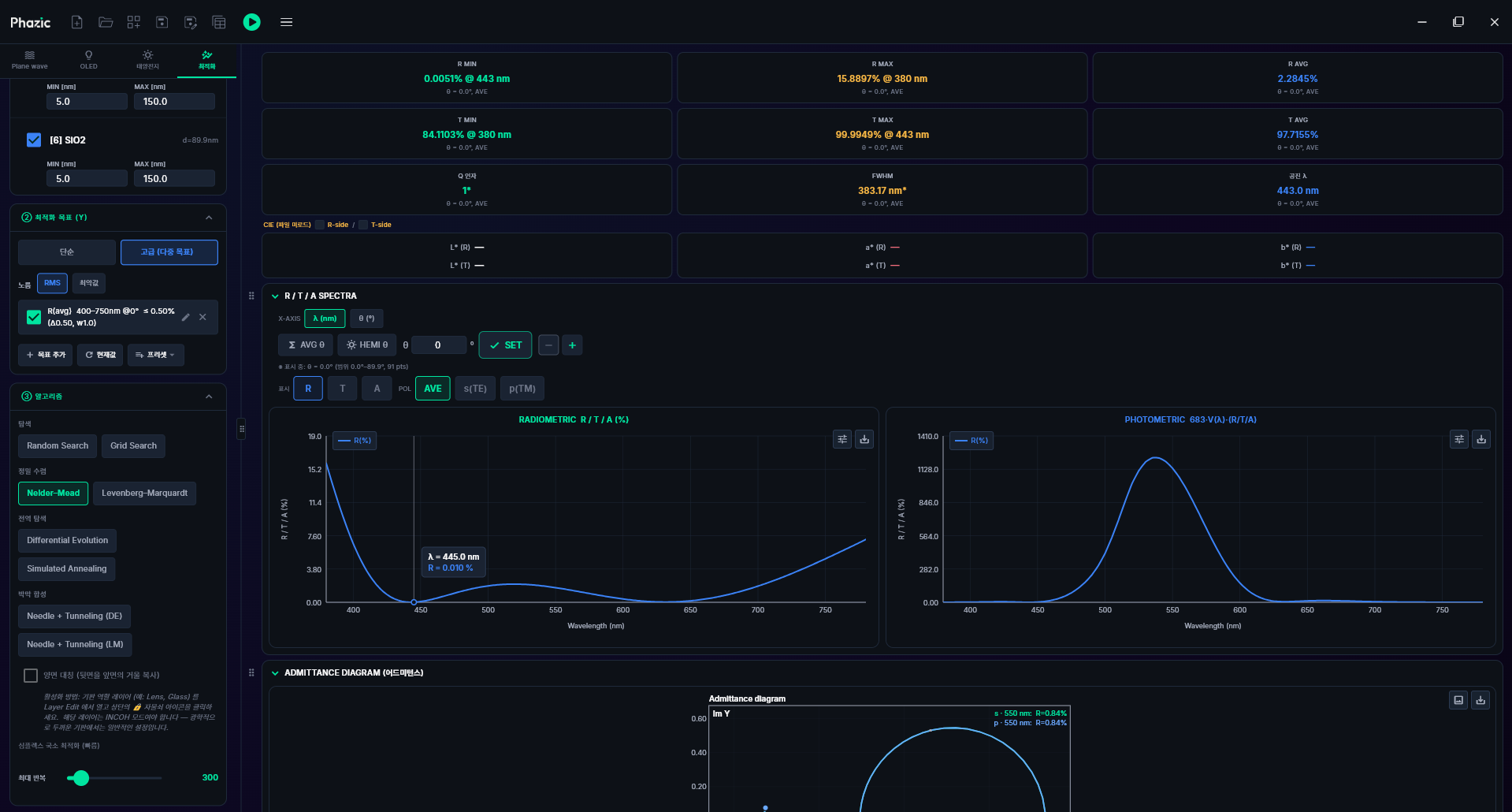
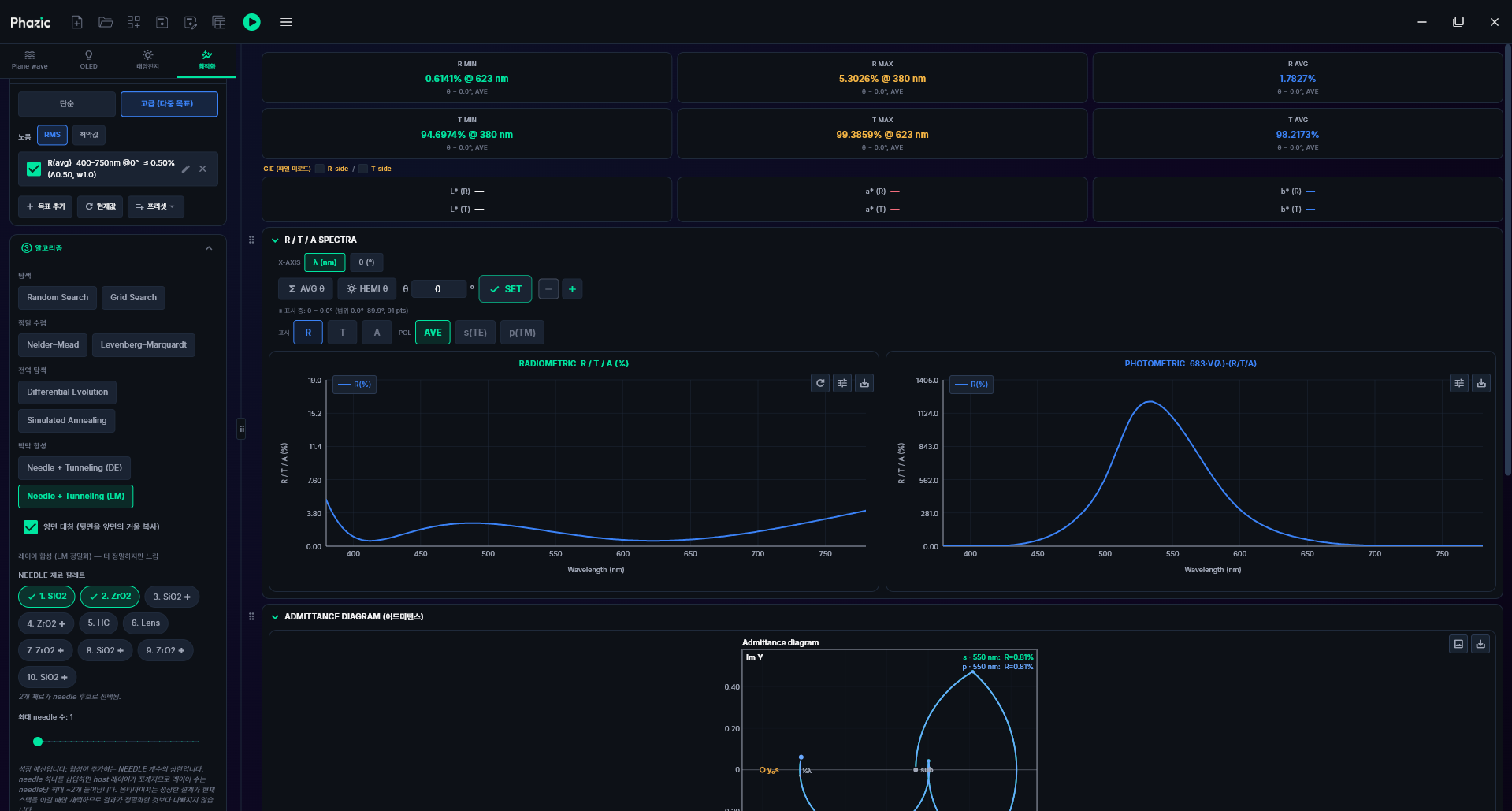
Needle + Tunneling does not only tune thickness — it inserts and removes layers automatically, discovering how many layers your target spectrum actually needs.

Phazicfinds the structure itself
06 · Ellipsometry

Ellipsometry fitting, built in

Recover thickness and (n, k) from measured Ψ·Δ — multi-angle joint fit, six dispersion models, Kramers–Kronig checked. Usually this is sold as a separate commercial package.

Phazicdesign + fit in one place
07 · OLED OCE

Dipole-accurate OLED outcoupling

Phazic models the emitter as an oscillating dipole in the cavity (Chance–Prock–Silbey / Furno) — capturing microcavity interference, the Purcell factor, and the AIR / SUB / WG / SPP channel split that a plain geometric escape-cone estimate misses. It reports OCE both ways, so a dipole result above the geometric bound flags a well-tuned cavity.

Phazicrigorous dipole model + geometric reference

Four unified
workflows.

Define a multilayer thin-film stack once — and use it across every module: R / T / A analysis, admittance diagram, dispersion (Phase / GD / GDD / TOD), spectroscopic ellipsometry, OLED efficiency, solar-cell Jsc, and automatic optimization.

Plane Wave

Multilayer Thin-Film
Optical Analysis

R / T / A spectra & ellipsometry

Method
  • Redheffer S-matrix (rock-solid numerical stability for thick absorbers & deep stacks)
  • COH + INCOH (Katsidis–Siapkas)
  • s / p / AVG polarization · incidence 0–89°
  • 18 starter templates
Output
  • R / T / A spectra · CIE 1931 / 1976 · L*a*b*
  • Admittance diagram · Kretschmann SPR · 2D R(λ, θ)
  • Ψ(λ) / Δ(λ) ellipsometry · dispersion (Phase / GD / GDD / TOD)
OLED

Organic LED
Efficiency Analysis

Dipole emission & OCE

Method
  • Chance–Prock–Silbey (1978)
  • 5-channel decomposition (AIR / SUB / WG / SPP / HOST)
  • ∥H / ⊥V dipole · Purcell F
Output
  • OCE · per-channel loss breakdown
  • Bottom / Top / Transparent with Thick TFE
  • Tandem OLED
Solar Cell

Solar Cell
Optical Performance

Jsc & SQ radiative limit

Standard Spectra
  • ASTM G-173 (AM1.5g / 1.5d / AM0)
  • IQE(λ) custom curves
  • Lambertian 4n² light-trapping
Output
  • Jsc (AM1.5g) · EQE = IQE × A
  • Active vs parasitic A(λ) · depth-resolved A(z)
  • Shockley–Queisser η · Voc / FF · 2T / 4T tandem
Optimize

Automatic Film Synthesis &
Thickness Optimization

Advanced multi-target · angle-robust optimization

Multi-target objectives · simultaneous
  • R / T / A · Rs−Rp · Ψ / Δ
  • Phase / GD / GDD / TOD · CIE Lab · V(λ)
  • Jsc · OCE · thickness — many lines at once (=/≤/≥, RMS / worst-case)
Algorithms · 8
  • Exploration: Random · Grid · DE · SA
  • Local Refinement: Nelder–Mead · LM
  • Synthesis: Needle+Tunneling (DE · LM)
What you can simulate

50+ applications,
6 categories.

PLANE WAVE

Optical Coatings & Filters

  • AR coatings
  • Dielectric mirrors / HR / DBR
  • Fabry-Perot Bandpass filter
  • Beamsplitters / polarization coatings
  • EUV multilayer mirrors
  • Tamm-plasmon structures
  • Coherent Perfect Absorber (CPA)
  • Structural color
  • TPV filters / radiative-cooling coatings
  • Low-E / smart windows
  • AR·VR HMD coatings
OLED

OLED & Light Extraction

  • OCE design
  • Bottom / Top / Transparent OLED
  • Purcell + 5-channel decomposition
  • 3-EU RGB tandem white OLED (per-EU OCE)
  • VCSEL planar-cavity emission
  • μLED / QLED / RCLED light extraction
  • Plasmon-loss quantification
SOLAR

Solar Cells

  • c-Si / a-Si:H / perovskite / OPV / DSSC / tandem
  • Per-layer absorption A(λ)
  • AM1.5 Jsc / EQE
  • Depth-resolved A(z) profile
  • Shockley–Queisser (2T / 4T)
  • 2-stack Tandem of Perovskite / Si
  • Lambertian 4n² light-trapping
PLANE WAVE

Ellipsometry Analysis

  • Spectroscopic Ψ / Δ (up to 4 angles)
  • Film-thickness measurement (multi-angle joint d)
  • n(λ), k(λ) extraction (INVERT / FIT)
  • 6 dispersion models
  • R/T fitting (reference match)
  • Semiconductor metrology · RMSE residuals
PLANE WAVE

Surface Plasmon Resonance

  • Kretschmann setup (prism / Au · Ag / bio)
  • Multilayer SPR (Si₃N₄ / black phosphorus / MXene / graphene)
  • TM-polarization angle scan · 2D R(λ, θ)
  • Cancer / SARS-CoV-2 / malaria / E. coli detection
  • Single- vs multilayer sensitivity
  • Arbitrary Au / Ag thickness — S-matrix stability
OPTIMISE

Stack Optimization

  • Multi-target weighted merit (RMS / worst-case)
  • Angle-robust (Single / Average / Worst-case)
  • Needle+Tunneling topology synthesis (add·remove layers)
  • Gradual evolution (index morphing)
  • Two-sided substrate synthesis · layer lock / thickness group
  • 8 algorithms × multi-start · DE default
View all applications — Full application index / Redheffer S-MATRIX v1.5.198
Future vision

An operating system for
optical engineering.

Phazic is not a single tool — it aims to be a unified operating system for the whole of optical engineering. From lab measurement to production-line decisions, from one researcher to a team of 100, every workflow connects on the same layer stack.

Unified optical workflow

Measure → analyze → optimize → validate in one environment

Extending to RCWA & anisotropy

The same star-product core generalizes to periodic structures (RCWA — gratings & metasurfaces) and anisotropic media (Berreman 4×4) — beyond 1D films into 2D/3D

AI-assisted optimization

Machine learning (ML) will accelerate the search space atop the physics-based engine

Beyond optics — radar (RAM)

Generalize the S-matrix with permittivity ε & permeability μ — magnetic radar-absorbing materials (RAM) and stealth